
Issue #002
The Autonomous COMMERCE Brief
March 12, 2026
The Big One This Week
Washington Finally Shows Up. The AV Industry Is Writing the Rules.
On March 10th, NHTSA hosted its first National AV Safety Forum in nearly a decade at DOT headquarters in Washington, D.C. and the guest list told the whole story. Waymo's CEO Tekedra Mawakana, Zoox's Aicha Evans, and Aurora's Chris Urmson were all in the room. Tesla was not. The company had an outdoor showcase in the parking lot.
That distinction matters. The three companies that presented are all operating under NHTSA's Standing General Order reporting requirements. Tesla has actively resisted the documentation framework that would put it in that category, so it was outside the room where that framework is now being written.
NHTSA is developing updated guidance on remote assistance standards, AV behavioral competencies, and safety performance metrics. The last time it updated its voluntary driving guidelines was 2017. A public comment period runs until April 10, 2026. Whatever comes out of that process will define the compliance baseline for every commercial AV operator in the U.S.
Meanwhile, Congress is moving in parallel. The SELF DRIVE Act of 2026, which cleared a House subcommittee last month, would raise the NHTSA vehicle exemption cap from 2,500 to 90,000 units per year, preempt state-level AV regulations, and establish the first federal safety standard dedicated specifically to autonomous driving. It's the third version of this bill since 2017. The first two stalled. This one has the Trump administration's tailwind behind it.
The ACB angle: Federal preemption of state AV rules is a double-edged signal. It could accelerate deployment in markets currently blocked by local politics, but it also makes nationally consistent curb infrastructure even more critical. When AVs can operate anywhere, the physical operating environment has to be ready everywhere.
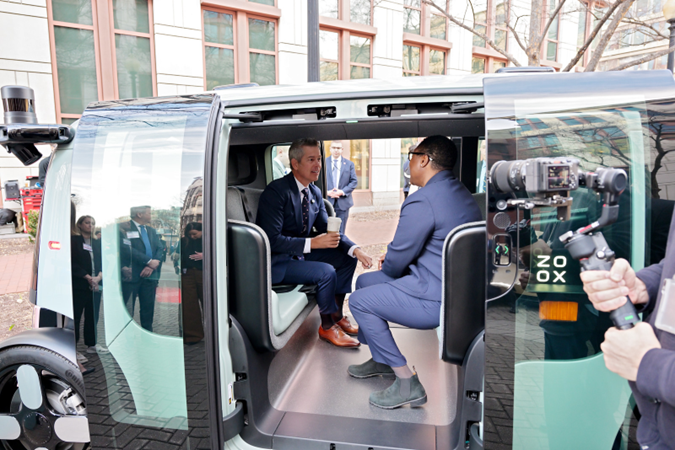
Image source: U.S. Department of Transportation
AV Roundup
An AV blocked an ambulance in Austin... and it went viral. A March 1st mass shooting in downtown Austin left an autonomous vehicle blocking emergency responders at the scene. The image spread widely, adding new urgency to ongoing debates about AV behavior in unplanned situations. It's the kind of edge case that ends up in regulatory hearings — and it already is. Congress members cited incidents exactly like this one during SELF DRIVE Act testimony.
Waymo is targeting 1 million rides per week by end of year. Now operating across more than 500 square miles in 10 cities and backed by over 200 million fully autonomous miles, Waymo is building toward a full public rollout in each new market. The company is also partnering with local municipalities and transit agencies, framing its fleet as a transit layer, not just a ride-hail competitor.
Serve Robotics + White Castle launch autonomous delivery on Uber Eats. Announced this morning (March 11th), the partnership brings Serve's sidewalk delivery robots to White Castle locations in Serve's active delivery zones. Serve has now deployed more than 2,000 robots across the U.S., serving over 3,600 restaurants. Earlier this year, Serve also acquired Diligent Robotics, expanding its footprint from sidewalk delivery into hospital service robots.
Grubhub kicks off drone delivery in the Northeast. Starting March 18th, Grubhub, Wonder, and drone company Dexa are launching the first drone food delivery program in the Northeast, a three-month pilot in New Jersey. The Dexa DE-2020 drone is domestically designed and assembled, a meaningful differentiator as supply chain scrutiny intensifies. The Northeast has largely sat out the drone delivery wave that's played out across Texas and suburban markets. This changes that.
Retail Reality Check
Grocers Are Rebuilding From the Curb In
U.S. supermarkets are in the middle of a full-scale e-commerce overhaul, and the battleground has shifted from warehouses to last-mile. Click-and-collect (BOPIS + curbside) now outpaces same-day home delivery — 31% of online grocery shoppers use pickup vs. 29% who use delivery. Grocers are redesigning stores to support this, converting footprints into hybrid fulfillment zones and dark store operations.
The data underneath this is striking: 92% of grocery retailers are already using AI for personalized shopping or marketing. Nearly a third of consumers say they'd let AI auto-reorder their household staples. The store isn't going away — but its role is being fundamentally redefined as a node in a logistics network, not just a place to shop.
What does this mean for autonomous commerce? The grocer that figures out curbside + autonomous delivery + smart inventory in one integrated operating model is the one that wins the decade.
Signals to Watch
- NHTSA's comment period closes April 10. This is the rulemaking that sets remote assistance standards for all commercial AV operators. If you have a position, now is the time to file it.
- Amazon Now just launched 15-minute grocery delivery in Brazil, expanding to eight cities by this week. Ultra-fast grocery is no longer a U.S.-only story, the global commerce race is accelerating.
- Simbe's Tally robot just became the first retail robot to earn UL 3300 safety certification, passing 40+ real-world safety tests. Shelf-scanning autonomy going certified is a signal that in-store robots are graduating from pilot to permanent.
- Zoox surpassed 1 million autonomous miles across its U.S. fleet this week, expanding testing to Dallas and Phoenix. Paid rides in SF and Las Vegas remain on track for 2026.
Autonomous Commerce Brief Take
The pattern this week is unmistakable: autonomous commerce is moving from proof-of-concept to policy. Washington is in the room. Retailers are redesigning their stores around autonomous fulfillment. And the robots — sidewalk, aerial, and wheeled — are stacking up partnerships faster than the curb infrastructure can absorb them.
That gap between deployment speed and physical readiness is exactly what this newsletter exists to track. The lane is changing. The question is whether the curb is ready for it.