Issue #004
The Autonomous COMMERCE Brief
April 1, 2026
The Big One This Week
Uber Just Bet $1.25 Billion on Rivian. The Robotaxi Arms Race Has a New Entrant.
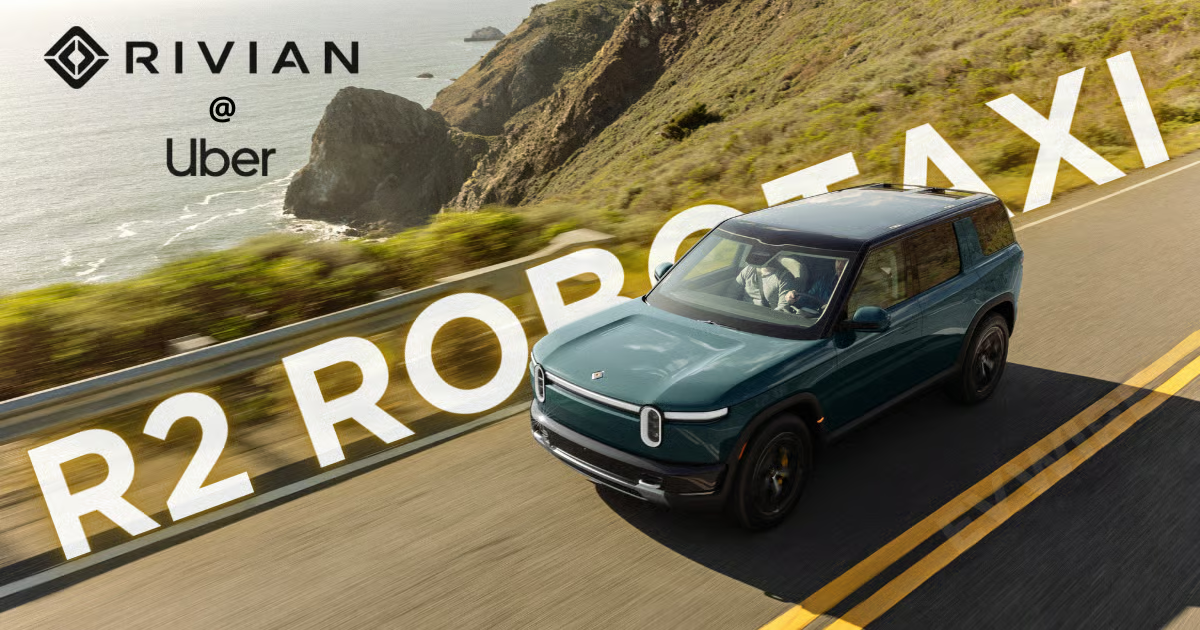
This week's most significant deal didn't come from a legacy AV company, it came from an EV maker that wasn't even in the robotaxi conversation a year ago. Uber committed up to $1.25 billion to deploy 10,000 fully autonomous Rivian R2 robotaxis across 25 cities by 2031, with an initial $300M down and an option to purchase 40,000 more units starting in 2030. First markets: San Francisco and Miami, in 2028.
The technical foundation is serious. Rivian's third-generation autonomy platform, launching in the R2 this year, runs 1,600 TOPS of AI compute via dual in-house chips and a full multimodal sensor suite. Rivian retains vertical control over the vehicle, the compute stack, and the software, using its consumer fleet as a data flywheel to train the autonomy system at scale.
The catch: Rivian has already said it no longer expects to hit profitability in 2027 because of how much it's spending on this bet. That's the trade the company made and it tells you something about how seriously the AV fleet market is being priced right now.
For Uber, the calculus is straightforward. The platform now spans Waymo, Zoox, VW, Rivian, Aurora, Nuro, Lucid, WeRide, Motional, Wayve, Avride, and more — across rides, freight, and delivery. Uber isn't building a car. It's building the operating system that every car runs on.
The ACB Angle: 25 cities. 10,000 vehicles. 2028. That's not far away — and every one of those rides needs a safe, designated place to begin and end. The curb infrastructure conversation starts now, not in 2027.
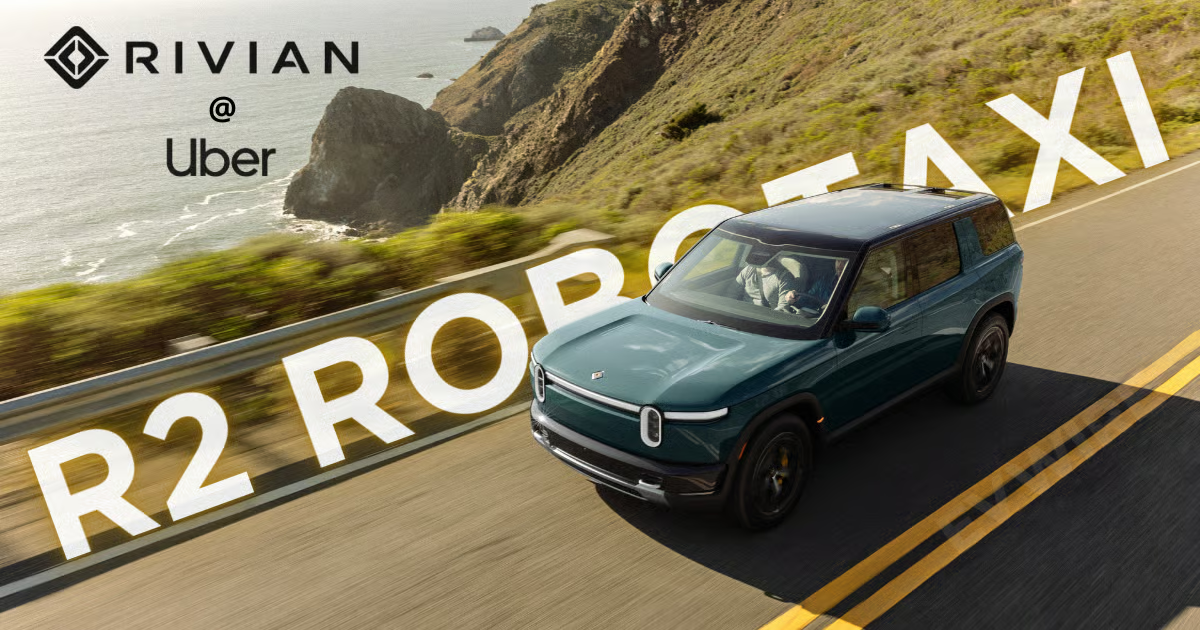
Image source: EV Wire
AV Roundup
NVIDIA GTC declared the "ChatGPT moment" for self-driving cars and signed four new OEMs. Jensen Huang took the GTC stage this week and announced expanded DRIVE Hyperion partnerships with BYD, Geely, Hyundai, and Nissan, four automakers that collectively build tens of millions of vehicles per year. GM, Mercedes-Benz, and Toyota are already in. The AV compute stack is consolidating around NVIDIA faster than most predicted.
WeRide debuted its Robotaxi GXR at GTC, targeting Singapore in April. Partnering with Grab for Southeast Asian deployment, the GXR runs NVIDIA DRIVE Hyperion and reportedly cuts autonomous driving suite costs by 50% and total cost of ownership by 84% compared to previous generations. Public rides in Singapore's Punggol district begin April 1st. The global robotaxi market just got its first major Southeast Asian commercial launch.
Aurora is on the doorstep of fully observerless freight. The company has tripled its driverless network to 10 routes across the Sun Belt, logged over 250,000 driverless miles with zero Aurora Driver-attributed incidents, and is set to haul freight without any partner-requested observer in Q2. New hardware launching in Q2 cuts costs by more than half and extends lidar range to 1,000 meters. The autonomous freight era for mid-size carriers is not a 2027 story anymore.
Autolane in the Room: Shoptalk 2026
Ben Took the Stage. Here's What the Room Was Saying.
Shoptalk Spring 2026 wrapped this week at the Mandalay Bay in Las Vegas — 10,000+ attendees, 200+ speakers, one theme: Retail in the Age of AI. Agentic commerce dominated every conversation. AI agents buying, fulfilling, and personalizing autonomously were the headline act. The infrastructure to receive those orders in the physical world? Mostly an afterthought.
That's exactly where Autolane came in. Ben Seidl, our Co-Founder and CEO, pitched on the Technology Stage Tuesday morning in the "Startup Pitch: Technologies Reinventing Customer Experience" session, putting autonomous vehicle orchestration in front of one of retail's most influential rooms of the year.
The message was direct: AI is rewiring discovery and fulfillment from the inside out, but the curb is still the final bottleneck. Every agentic order, every same-day delivery, every robotaxi drop-off eventually has to land somewhere in the physical world. Autolane is the connective tissue between the software layer the room was obsessing over and the real-world infrastructure that makes it all work.
In a conference full of platforms, APIs, and dashboards, we were the only ones talking about the curb.
Signals to Watch
- NHTSA comment period closes April 10. The new federal AV guidance on remote assistance standards and behavioral competencies is still being shaped. The comment window is open for three more weeks... this is how the rules get written.
- Tesla Cybercab production begins in April at Gigafactory Texas. The first no-steering-wheel, no-pedal vehicle produced at any real volume by a major automaker. Month-one production numbers will set the tone for the rest of the year.
- Shoptalk's dominant theme, agentic commerce, has a physical infrastructure problem. AI agents can place an order in milliseconds. Getting it to the door still takes a van, a curb, and a clear operating zone. That gap is where the next three years of autonomous commerce get decided.
- WeRide in Slovakia, Zoox in Dallas and Phoenix, Nuro + Lucid on deck. The global footprint of commercial AV operations is expanding faster than any single market map can capture. 2026 is looking more and more like the year the map becomes unrecognizable.
Autonomous Commerce Brief Take
Here's what we kept thinking about walking the floor at Shoptalk: there are tens of thousands of people in this industry working incredibly hard to make commerce faster, smarter, and more accessible. AI agents that shop for you. Same-day delivery for families who can't get to a store. Robotaxis that give mobility back to people who lost it. The ambition in that room was genuinely inspiring.
But ambition needs infrastructure to land. Every one of those breakthroughs, the agentic order, the autonomous delivery, the driverless ride, ends at a curb somewhere. And right now, most of those curbs aren't ready.
That's not a criticism. It's an opportunity. The world gets meaningfully better when the physical environment catches up to the technology being built on top of it. More people get access to faster, cheaper, safer commerce. Cities get quieter and less congested. Small businesses get delivery infrastructure that used to be reserved for Amazon.
That's the future we're building toward. Not just a better product, a better outcome for the people on the other side of every autonomous trip.
The lane is changing. Let's make sure it leads somewhere worth going.