Issue #20
The Autonomous COMMERCE Brief
July 16, 2026
BIG STORY
Autolane Just Went Live Across Phoenix In 113 Degree Heat And A Haboob. The Austin Pilot Just Proved The Model Works Too.
This week Autolane went physically live across three of Phoenix's biggest malls, while the Tso Chinese Takeout & Delivery launch in Austin quietly crossed into its second week of real customer data. Two different proof points, same story. The infrastructure works, and it works in conditions most companies would rather test in a lab than in the field.
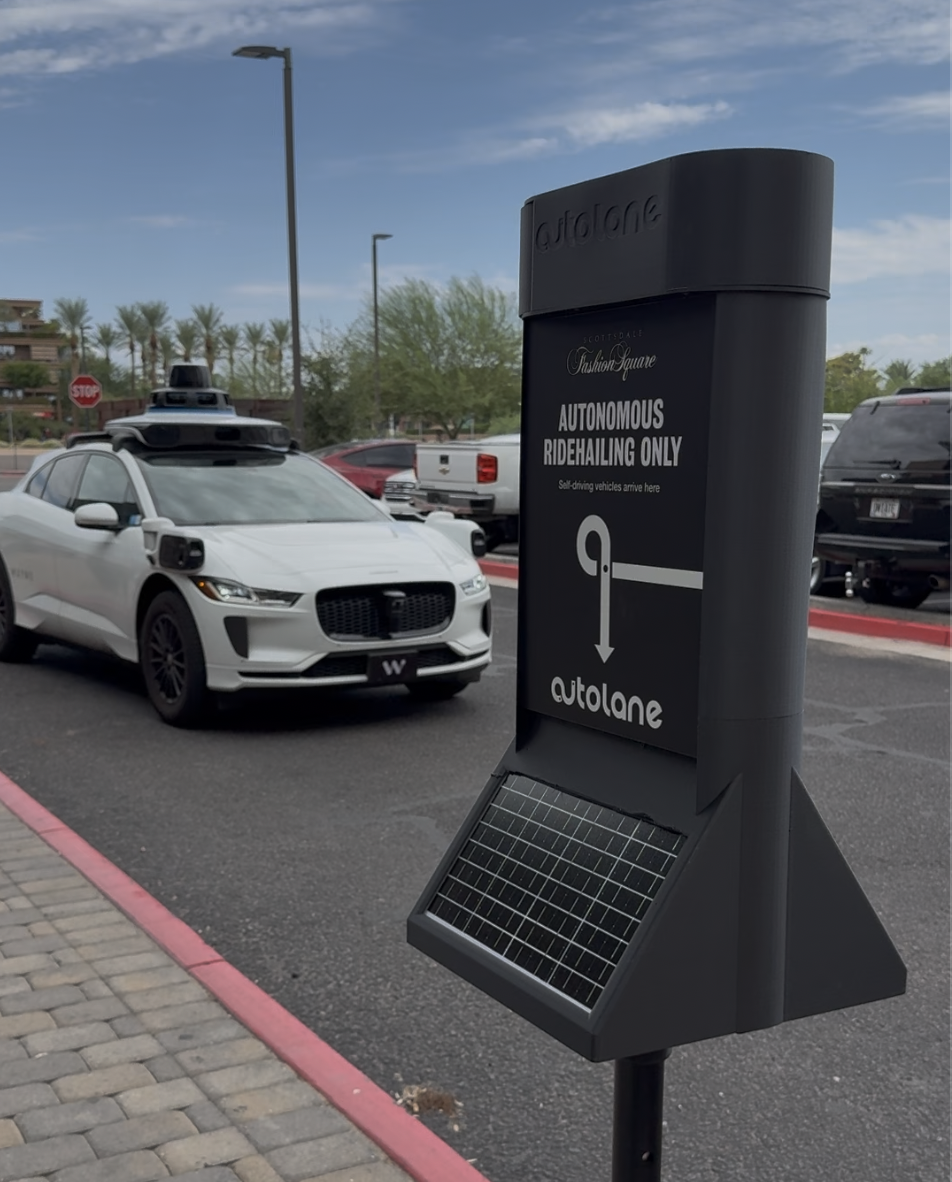
Start with Phoenix… Chandler Fashion Center, Scottsdale Fashion Square, and Arizona Mills are now live with six Autolane Curbside Signs coordinating pickups and drop-offs at the curb. Getting there meant installing hardware in 113 degree heat and, on one memorable afternoon, a haboob (look it up) the rolling dust storms that blow through the Phoenix valley with almost no warning. The signs withstood. The install crew did not have quite as easy a time of it, but the hardware performed exactly as designed in the harshest conditions Autolane has tested in yet. Shout out to our team member Chad Wagner for fighting the good fight.
That is not a small detail for the REITs and retailers watching this space. A curbside sign that only works in mild weather is a curbside sign that fails the first time a city has a bad week. Phoenix in July is about as hard a stress test as hot American weather gets, and the signs are still online, still detecting, still coordinating traffic.
Meanwhile in Austin, the Tso Chinese launch is generating exactly the kind of data Autolane needed to see. Two weeks in, the integration is holding: Nash routes every order, Autolane orchestrates every vehicle to the curb, and not one delivery has required a human to step in. Daily delivery counts are climbing, and the autonomous share of those deliveries is growing week over week. Customers who have used the autonomous option keep describing the same thing: no wrong doors, no stranger showing up at the wrong spot, no awkward moment at the porch.
One customer put it simply: "It was great, communication was great, no issues with getting my meal placed in difficult spots like with delivery drivers." That is the exact trust question the rest of this issue gets into below.
Two different proof points, one thesis. Hardware that survives a haboob and a customer experience that survives real weeks of real orders both say the same thing. This is not a lab demo anymore. For the operators still deciding whether autonomous infrastructure can hold up outside a press release, Phoenix and Austin just answered that question in the same week.
AV ROUND UP
Washington Told AVs To Stop Blocking Ambulances. A Fourth Of July Traffic Jam Started The Conversation. NHTSA's administrator issued a directive this week making clear that autonomous vehicles interfering with first responders or law enforcement is unacceptable, a direct response to robotaxis getting stuck in San Francisco traffic during July 4th celebrations. It is the clearest federal statement yet that public trust carries more weight than uptime.
Rivian Just Raised $1.32 Billion. Some Of It Is Headed Straight Into Uber's Robotaxi Fleet. Rivian priced a stock sale this week to raise $1.32 billion, fresh capital landing right as the company ramps its new R2 SUV and works toward the 10,000 autonomous R2 robotaxis Uber has committed up to $1.25 billion to deploy by 2031. Rivian also raised its 2026 delivery forecast to 65,000 to 70,000 vehicles. The company still is not profitable, and this round says as much about how expensive scaling a robotaxi fleet is as it does about demand for the R2 itself.
Zoox Is Done Testing. Austin And Miami Get Public Rides This Year. Zoox confirmed its purpose-built robotaxi will open to members of the public in Austin and Miami later this year, following the production-intent redesign it pulled from feedback across 500,000 rider trips. The doorless, steering-wheel-free vehicle is no longer a science project. It is about to carry paying strangers.
Regulators Are Deciding Whether Robotaxis Even Need A Brake Pedal. NHTSA's comment period on dropping manual brake control requirements for purpose-built autonomous vehicles runs through July 27. The vehicles built without pedals or a steering wheel, Zoox and Cybercab among them, have been operating in a regulatory gray area. This is the rule that decides whether that gray area becomes a green light.
THIS WEEK ON LINKEDIN: Brittain Ladd Says Customers Aren't Choosing Autonomous Delivery For The Discount. They're Choosing It For The Locked Trunk.
Brittain Ladd, a former Amazon executive and one of the most followed voices in autonomous commerce, posted something this week every operator in this newsletter should read twice.
His argument: the industry has been modeling autonomous delivery as a cost story, cheaper and faster than the alternative. But the operators he has been talking to are discovering something different. Customers are choosing autonomous delivery even when it is not cheaper and not faster, because it removes the one part of delivery people have quietly disliked for years, a stranger handling their food or groceries with no way to verify what happened before it arrived. Sealed at the restaurant, locked in transit, opened only with the customer's own code. Not a delivery. A verifiable chain of custody.
That is not an abstract argument to Autolane. It is the exact experience the Tso Chinese Takeout & Delivery launch is producing in Austin right now. Customers who have used the autonomous option keep describing it the same way, no wrong doors, no stranger at the porch, no awkward tipping standoff. Ladd is describing the reason. Austin is producing the proof.
Read his full post here Linkedin
THE LAST 50 FT
Producer Kyle stepped out from behind the scenes and joined Ben on Ep #15 of The Last 50 Ft this week for their first ever duo episode without Cam, who was somewhere on a ferry in the San Juan Islands celebrating his anniversary.
The episode is the deepest dive yet into how the Tso Chinese Takeout & Delivery autonomous delivery launch actually works, from the Nash integration to the text message opt-in to the open trunk button.
Ben also shares an insight from the first week of live operations that stopped us in our tracks: the same reason women loved Waymo from day one is showing up in autonomous delivery too. And it has nothing to do with cost savings.
Give it a listen on Spotify, YouTube, and Apple Podcasts.
THE AUTOCOMM BRIEF TAKE
This newsletter has said for months that the infrastructure question was the one holding autonomous commerce back. This week gave two answers in the same seven days. A curbside sign held up through 113 degrees and a haboob. A launch in Austin kept growing its autonomous share while customers described an experience that finally removed the part of delivery they never trusted in the first place.
Neither of those happened for an audience. Both are what shows up weeks in, when the hardware and the model actually have to hold up in the field with no one watching. Austin proved the software. Phoenix further proved the hardware. Safety is the thread running through every piece of this issue, from NHTSA telling AVs to stay clear of first responders to a customer who never had to wonder whether their order was handled by a stranger. It is the same thread running through this week's episode of The Last 50 Ft above. Whoever is still waiting to see this work in the real world before they move can stop waiting.
The lane is changing. Let's make sure it leads somewhere worth going. 🏁
Subscribe to the Autonomous Commerce Brief: goautolane.com/newsletter-signup